scr2

mardi 6 août 2019

Back-To-School Shopping Guide 2019: Men's Fashion Essentials


check who-are-most-powerful-women-in-politics -> https://oko.sh/ZtYMgcH

This story was written in collaboration with 
Forbes Finds. Forbes Finds covers products and experiences we think you’ll love. Featured products are independently selected and linked to for your convenience. If you buy something using a link on this page, Forbes may receive a small share of that sale.
Adidas
Shopping for the perfect back-to-school outfit can be nerve-wracking, especially if you’re a college student looking to reinvent yourself or stand out. But crafting a new ensemble for your first day back can also be thrilling because it's important not just for appearances, but also for your confidence. 
A new school year is a wonderful time to rebrand yourself and it starts with personal style. It’s time to leave the funny graphic tees behind and adopt a more sophisticated look.
H&M Basic Tee
You have to start with the basics. Buy a handful of these H&M basic tees as a part of your closet essentials. You'll appreciate always having something comfortable to throw on. Having a solid collection of basic tees will ensure you’ll be ready for any occasion, including running late to class, in minutes. Not to mention, it can double up as your pajamas, too, should you be too lazy after a long night of studying--or partying. 
Shop Now
Cotton Traders Short Sleeve Rugby Shirt
Cotton Trader
Short-sleeve rugby shirts are trending. They're sporty, comfortable and appropriate for a wide variety of occasions. And you can never look underdressed or overdressed to any event. They also give off the impression that you actually play sports, even if you don’t. Short-sleeve rugby shirts also can make you look a bit more muscular than normal, especially if you have a basic tee underneath. 
Shop Now
Adidas SST Windbreaker
Urban Outfitter
Leave your typical college-branded hoodies at home and pick up a stylish windbreaker like this vibrant orange version from Adidas instead. These pieces are flexible as they can work for fall, spring and rainy summer days. They're also easy to style. You can throw these over your basic tees for a more laid-back and casual look. 
Shop Now
Goodfellow & Co Skinny Fit Jeans
Target Goodfellow & Co Skinny Fit Jeans
Target
A well-fitting pair of jeans with a good fade and some stretch will be your best friend for years to come. The Goodfellow & Co Skinny Fit jeans from Target is a must-have, especially if you're on a tight budget but still want premium denim. And if you're looking for versatility, go with a darker color as they'll be easier to pair with other items in your closet.
Shop Now
Nike Air Max
Don’t be afraid to be eccentric with your footwear—especially if you’re already wearing a brightly colored windbreaker. Sneakers, when kept clean, are fashionable and practical, especially if you have to walk long distances between classes. I love the Nike Air Max because their exotic appearance. 
Shop Now
Even H4 Headphones
Even H4 Headphones
Weareeven.com
Beats and Apple AirPods are still cool. But coming into trend this year are headphones that can create a personalized audio-profile specific to your ears. These headphones are an audiophile’s wet dream and tend to ask a hefty price, usually over $400. But this year, you can step up your audio game with the Even H4 headphones for considerably less. The Even H4 lets you create an audio profile, called an earprint, via an app. Using your new earprint, the Even H4 will be able to give you the best-personalized listening experience. 
Shop Now

On the Town: Air travel theme soars at fundraising fashion show

Taking a trip back in time for a nostalgic look at the fashionable days of air travel, members of the La Providencia Guild of Children’s Hospital Los Angeles gathered for their annual summer fashion show and luncheon this past Saturday at Lakeside Golf Club in Burbank.
Presented with the theme “Fly Away With Me,” this year’s event showcased fashions, jewelry and accessories from the guild’s thrift shop, which were modeled by guild members and special guests.
La Providencia Guild of Children’s Hospital Los Angeles
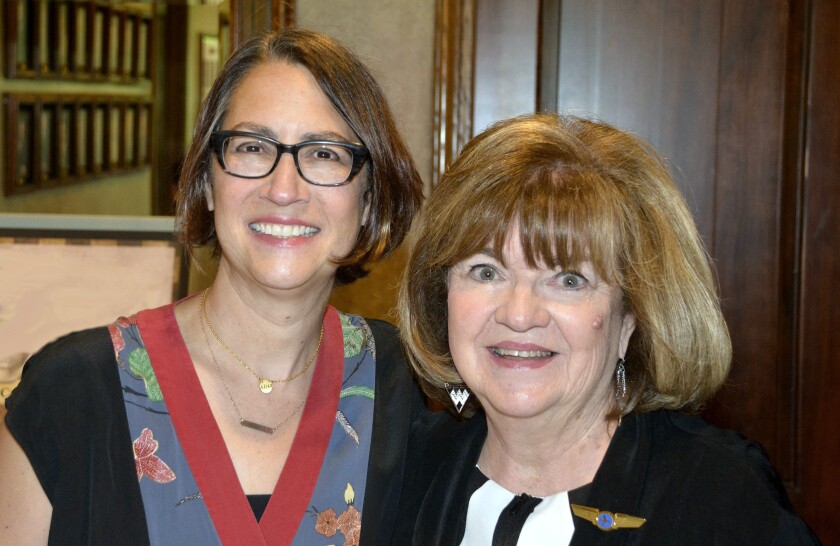
La Providencia Guild President Sue Meckley, right, and Vice Presdient Nancy Wiggins, welcomed members and guests to Saturday’s fashion show and lunch.
(David Laurell/Burbank Leader)
Welcomed by Sue Meckley, guild president, and the event’s co-chairs, Donna Salant and DeeDee Rowlands, organization members, along with family members and friends, were updated about the organization’s news and upcoming events prior to the day’s main event coordinated by Sue Ann Gordon and Rosemarie Witten.
Among the special guests in attendance were state Assemblywoman Laura Friedman (D-Glendale), the guild’s 2019-20 officers, Nancy Wiggins, Ann O’Donnell-Gardner, Jill Kessler and Glenda Jones, and Providence St. Joseph Medical Center Guild members Ollie Vick, Linda Brundage and Mona Marian Bielby Enos.
La Providencia Guild of Children’s Hospital Los Angeles
Overseeing the show that highlighted fashions one may wear while jetting off to Paris, Barcelona, or beyond, were Sue Ann Gordon, left, and Rosemarie Witten.
(David Laurell)
The tradition of putting on a summer fashion show can be traced back to the late 1940s, when guild members would stage yard sales to show off and sell used clothing and other items.
In 1958, they transitioned from yard sales to operating a brick-and-mortar thrift shop that was located on San Fernando Boulevard.
La Providencia Guild of Children’s Hospital Los Angeles
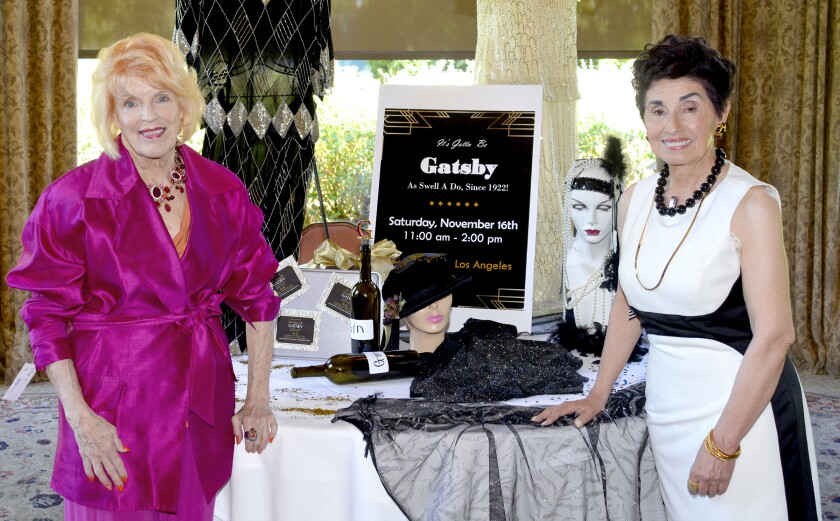
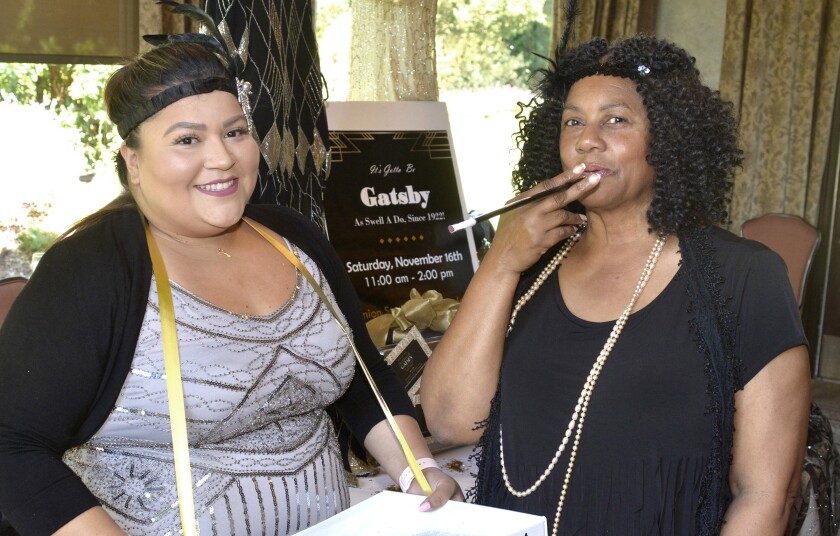
Getting the word out on the guild’s next big event were Rebecca Jones, left, and Glenda Jones, who will chair the guild’s November Great Gatsby-themed winter gala.
(David Laurell)
After a move to Magnolia Boulevard in November 2007, the guild relocated the store to its current location at 3301 W. Burbank Blvd., where, staffed by volunteer guild members, the organization offers a wide array of clothing, jewelry, accessories, furniture, books, household items, artwork and gifts.
Funds raised at the guild’s events and the Burbank Boulevard thrift shop go toward the current projects the group supports, which include the Associates Endowed Chair for the Chief of the Children’s Orthopedic Center and the Associates Endowment for Liver and Intestinal Research.
La Providencia Guild of Children’s Hospital Los Angeles
Former-guild President Veronica Chavoor, right, welcomed State Assemblywoman Laura Friedman to Saturday’s fashion show.
(David Laurell)
The guild’s next major event will be a Roaring ‘20s-themed day inspired by F. Scott Fitzgerald’s iconic characters in “The Great Gatsby,” which will be held on Nov. 16 at Union Station in Los Angeles.
For more information about that event, the La Providencia Guild of Children’s Hospital Los Angeles, guild membership, the thrift store or other upcoming events, visit laprov.org or call (818) 845-6606.
DAVID LAURELL may be reached by email at dlaurell@aol.com or (818) 563-1007.
Support our coverage by becoming a digital subscriber.

The rise and fall of Halston, the man who redefined American fashion


Watch CNN Films' "Halston" on Sunday, August 25 at 9 p.m. ET/PT.
There is a scene in "Halston," a new documentary about the enigmatic fashion designer Roy Halston Frowick, in which his former assistant Tom Fallon recounts a story that still shocks -- even half a century on.
Halston, who made hats for New York's high society in the early 1960s before becoming a household name, was invited to a grand meal at a client's house in Long Island. As they sat down to eat, two men remained standing, refusing to be seated unless Halston and another diner -- whom they attacked with homophobic insults -- were removed.
"Tom," Fallon recalls Halston saying to him, "I just need you to understand that you and I could not hope to be anything more than trained fa**ot poodles to jump through the hoops of these rich people."
But Halston would prove his own pessimism wrong in almost every way. Over the next two decades, he rose to become perhaps the single most influential figure in the history of American fashion.
Halston with Betty Ford, Elizabeth Taylor and Liza Minnelli at Studio 54. Credit: Robin Platzer/The LIFE Images Collection/The LIFE Images Collection via G
The first superstar fashion designer
The documentary tells the story of how Halston redefined the role of the American fashion star. Irresistible to the media and defined by trademark designs, he mixed high fashion with low, as well as producing a perfume range, diffusion line and licensed brand extensions bearing his name.
At the dawn of the 1960s, old rules were already being broken -- and Halston would do as much as anyone in fashion to usher in the radical changes that followed. By the 1970s, he had created a style that spoke to the freedom and youthful energy of the disco generation, becoming the decade's "quintessential designer," says Patricia Mears, deputy director of the Museum at the Fashion Institute of Technology (FIT) in New York.
But "Halston" also shows how, in his megalomaniacal desire to "dress all of America," the designer came undone at the hands of the fashion and business powers he couldn't bend to his will -- and at the hands of his own vices (Halston reportedly spent thousands of dollars a week on cocaine at the height of his power).
Mears tells CNN that America's first superstar fashion designer -- one who brought an unprecedented diversity of racial backgrounds and body shapes to the runway -- offered a "cautionary tale."
"He was the great shooting star of fashion in the 1970s and early 1980s, but he burned out very quickly too," says Mears, who curated the designer's work in the 2015 FIT show, "Yves Saint Laurent + Halston: Fashioning the '70s."
"The things that we see today -- designers becoming part of large conglomerates or growing their companies so that they're worth billions of dollars -- (were) probably made easier because of Halston's pioneering efforts. He was the first to really build a business in the United States to that level, and he was the first to really crash and burn."
Halston in New York in 1980. Credit: SAUER Jean-Claude/Paris Match Archive/Paris Match via Getty Images
Dancing clothes
Throughout the 1970s, Halston was often flanked by a squad of models and celebrities, including Anjelica Huston, Bianca Jagger and Liza Minnelli. In the documentary, women who wore Halston's creations recall his ability to use a single piece of fabric and transform it into a beguiling shape that shifted on the wearer's body.
"His clothes danced with you!" says Minelli who spent decades as Halston's close friend and confidant.
By the end of his 20s, Halston had already designed the pillbox hat that Jackie Kennedy wore to her husband's presidential inauguration. By his early 40s, he had helped break France's global dominance of fashion with 1973's landmark Battle of Versailles Fashion Show, which pitted top American designers like Halston and Oscar de la Renta against famous French peers including Saint Laurent and Christian Dior.
Through headline-grabbing stunts -- he was responsible for Jagger riding a white horse around Studio 54 at the height of the nightclub's notoriety -- he cemented his position as America's best-known designer. Yet Halston continued to micro-manage his empire, hand-designing clothes worn by everyone from American Girl Scouts, whose official uniforms he redesigned, to Avis car rental workers and US athletes at the 1976 Olympics.
Halston redefined the role of the American fashion designer. Credit: John Preito/Denver Post/Denver Post via Getty Images
Democratizing fashion
"Halston" is the brainchild of Frédéric Tcheng, the French-born documentarian behind 2014's "Dior and I." The new documentary, which he wrote and directed, exposes two sides to the American designer.
The film depicts Halston as an aspirant, Tom Ripley-esque figure, whose rise from obscurity was made possible by a succession of masks he hid behind, shielding his true identity with eccentricity and a flair for showmanship. At the same time, Tcheng's film argues that he was a democratizer of fashion who dreamed of breaking the great class chasm to bring elegance to the American everywoman (whose dignity and power he had seen in his own midwestern mother).
Despite his once-huge public profile, Halston mostly kept his own story hidden. In interviews, he repeatedly rebuffed questions about his past: "The past just doesn't interest me so much," he squirms in one scene.
In reality, he was from a working-class home in Des Moines, Iowa, and spent his youth in provincial midwestern cities before landing a job as a custom milliner at New York's Bergdorf Goodman department store. His work there culminated in Jackie Kennedy's aforementioned pillbox hat, a radically clean shape that inspired copies across the US.
But it was upon leaving Bergdorf that Halston -- following in the footsteps of milliners-turned-fashion designers like Coco Chanel and Jeanne Lanvin -- took what Mears calls his "quantum leap" into designing clothes.
He scored early hits by masterminding the hot pants craze and designing "Ultrasuede" suits, which became best-sellers for an emerging generation of young professional women. He then began developing his own signature style.
"The 1970s was all about youth, dancing, being sexy (and) being carefree," says Mears. "And his lifestyle, as well as his clothing, embodied that. But he also maintained a really strong element of elegance. His clothes were never disheveled.
"Always clean, always very modern-looking. At the same time, the clothes were meant to be worn often without bras -- they were often halter necks or cutaways, so you saw skin and you also saw a lot of the female body very clearly underneath the clothing."
Halston in 1980. Credit: SAUER Jean-Claude/Paris Match Archive/Paris Match via Getty Images
An enduring legacy
Halston's impact is clearly visible in the work of designers like Tom Ford, whose glamorous late-1990s womenswear bears his influence, according to the Washington Post's fashion critic Robin Givhan. By making everyday outfits luxurious, he was also an early pioneer of "athleisure," adds Mears.
What's more, his business empire set a template for today's ambitious designers.
In 1973, he signed a deal with food conglomerate Norton Simon, which also owned Max Factor cosmetics, giving him huge financial backing (though the deal meant he no longer owned his own name). Then in 1982, he made a $1 billion deal with JCPenney, the affordable department store where he had shopped as a child. Today, collaborations between major designers and high street brands like H&M are common, but at the time it was major news. The decision resulted in his label being booted out of high fashion stores including Bergdorf Goodman, which had given him his start.
Model Alva Chinn, one of his group of so-called "Halstonettes," tells Tcheng that the JCPenney deal transgressed the boundaries of exclusivity that fashion fiercely protected: "He stepped out of the norm, and people like their boundaries that are set between them and those."
"It was pure hell after that," says Don Friese, Halston's vice president of sales, who recalls high-fashion brands cutting orders to distance themselves from the increasingly accessible label. "He realized he'd done the wrong thing."
Haltson was subsequently removed from the helm of the business that bore his name. This, and his premature death from AIDS-related complications at the age of 57, make up the film's tragic second act, which tells of how he disappeared from American fashion. In losing his name, he lost control of his legacy. The brand, now known as Halston Heritage, has been sold on repeatedly in the 21st century, with former president Sarah Jessica Parker and previous co-owner Harvey Weinstein among those who failed to recapture the magic.
"In some ways, we see this as a tragic tale," says Mears. "But it's also a good tale, I think, to tell.
"I hope in the midst of this we don't forget he was also a great pioneering designer. He didn't become famous just because he was good at self-promotion -- he became a great designer, and remains a great designer in the minds of many, because he was so revolutionary."
"Halston" airs on Sunday August 25 at 9PM ET/PT on CNN.

Fall Fashion: The New Androgyny

28 DRESSING RULES THAT EVERYONE SHOULD LEARN ONCE AND FOR ALL


Aug 5, 2019
Crisply tailored suiting gets dressed up with corsets, ruffled collars and classic ties for T’s fall Women’s Fashion issue cover story, enchantingly captured by the London-based photography duo Mert Alas and Marcus Piggott and styled by Olivier Rizzo. Down to the details — jeweled buttons, transparent blouses and velvet trims among them — these fashions subvert gender lines.
The fall Women’s Fashion issue is on newsstands Aug. 18.
Models: Aaron Sirainen at IMG Models, Cyryl Smolenski at PRM Agency, Anok Yai at Next Management, Fernando Lindez at Premier Models, Alex Sinclair at the Squad Management, Kacper and Oskar Grzelak at Success Models, Hayley Ashton at Muse Management, Anisha Sandhu at the Society Management, Yilan Hua at New York Model Management and Naomi Chin Wing at IMG Models. Hair: Anthony Turner at Streeters. Makeup: Lucia Pieroni at Streeters. Casting: Anita Bitton at Establishment Casting. Production: Across Media Production. Manicure: Lauren Michelle Pires at D&V Management. Digital tech: Niccolo Pacilli and Marco Torri. Photo assistants: Sinclair Jaspard Mandy, Ben Coppola and Hristo Hristov. Hair assistants: Claire Grech, John Wooley, Mee Kyung Porter and Simon Khan. Makeup assistants: Shelley Blaze and Lois Moorcroft. Seamstress: Michelle Warner. Stylist’s assistants: Niccolo Torelli, Letizia Maria Allodi, Aurora Burns and Phillip Smith. Video editor: Ruth Gibbs.

Asian is not one appearance': Why I'm pushing to include plus-size Asian women in fashion


Michelle Elman, a body confidence coach based in the U.K., said she has felt excluded from the fashion industry as an Asian woman who identifies as "plus-size."
The author of the memoir, "Am I Ugly," set out to change that, organizing a photo shoot where she posed alongside six other Asian women of different sizes and skin tones. Her goal: to break stereotypes of Asian women in the U.K. "plus-size community" and fashion overall.
Elman teamed up with photographer Linda Blacker on the passion project and posted the photos on her Instagram account, @scarrednotscared, where it immediately sparked a conversation on social media about the inclusion of Asian women in media, advertisements and fashion.
Read on for Elman's essay on the inspiration behind the shoot and why she wants others to see that "plus-size Asian women exist."
A campaign to show people the diverse range of beauty they were missing out on.
Having worked as a body confidence coach, I have noticed that there is so much of a focus on size diversity that often race diversity gets left behind.
Even in adverts which are praised for being inclusive and diverse, it is often only one person of color to count for multiple continents.
Michelle Elmer and photographer Linda Blacker collaborated for this photoshoot of plus-size Asian women to call for more inclusivity of Asian women in the fashion industry.
Particularly within plus-size, the lack of Asian representation is noticeable and I believe it is due to the stereotype of Asian women being petite and of course, if that’s the only Asians we see, this stereotype is perpetuated and the pressure of Asian women to conform to the beauty ideal is greater.
Although I have been talking about this for years online, in March I started making a conscious decision to try to actually make some progress in the industry and started having conversations with the brands I work with as an influencer. Unfortunately, despite a lot of agreement on the surface that this was a problem, there was little change to be seen. That’s when I took it into my own hands.
Linda Blacker and I had previously worked together on a photo shoot last summer, and when she saw my posts, she reached out to suggest creating a campaign to show people the diverse range of beauty they were missing out on.
Our idea was simple: we wanted to create a fashion shoot that deserved a place in magazines and the mainstream media.
We could have never prepared for the amount of attention this has received. The fact that the image has gone around the world amazes us, but just goes to show that the need for representation is there. The sentiments from the model on the day of the photo shoot mirrored this.
Asian is not one appearance.
Every woman had stories of being previously body shamed and being taught that to be Asian meant a certain size. All races have this pressure to be thin, but when it becomes cultural as well, the pressure is only enhanced.
The other issue we wanted to acknowledge with this photo was the fact that the lack of Asian representation has meant that Asia is lumped together as one category when actually every country in Asia has its own culture. It would be very unusual for a German person to be asked to represent French people, yet Asian people are asked to do this all the time and speak on behalf of an entire continent.
We hope this photo demonstrates that "Asian" is not one appearance.
People want to feel included and ultimately brands have a responsibility to acknowledge that their customers want to feel seen.
Having a more diverse idea of beauty benefits and empowers everyone.
Body positivity is for all marginalized bodies and we need to make sure that when we talk about being inclusive, we are being intersectional across ability, age, gender and sexuality.

lundi 5 août 2019